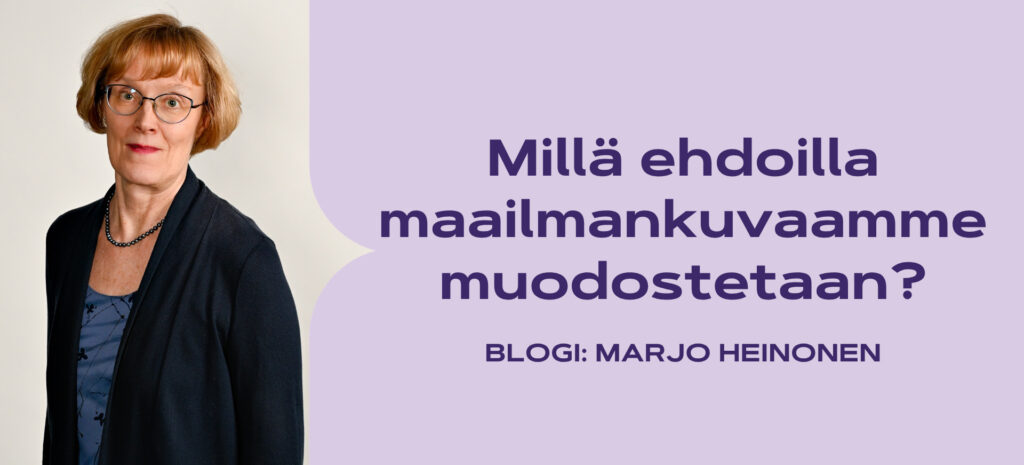
In her blog, Executive Director Marjo Heinonen highlights the role of the media in strengthening the inclusion and social visibility of people with disabilities.
Inclusion is a promise that no one will be left out. It is not a campaign, a project, or a single act, but a way of being and living together. When we see humanity before limitations, we build a society where everyone can belong, participate, and be accepted for who they are.
Barriers are not just physical. They arise from attitudes, words, and ways of interacting. Prejudices often stem from ignorance and fear—and they close doors more than any staircase or threshold. Breaking down these barriers starts with each and every one of us. The media also has a significant role to play.
Journalism does not reflect the daily lives of the 1.2 million disabled Finns
We live in a reality where physical and functional differences are still not considered a normal part of life. Although we have made progress toward inclusion, the “normal” portrayed in the media is still the able-bodied person.
Yet an estimated 1.2 million people in Finland have an disability—nearly one-fifth of the population.
When we talk about inclusion, we don’t mean only accessible doors and ramps. We’re talking about attitudes, opportunities, and the right to belong to community. In the media, this means that people must be able to recognize themselves in journalistic content: in everyday stories, opinion pieces, and expert roles.
For society to feel like our own, stories about our lives shouldn’t appear in the media only as negative narratives or heroic myths. Everyone has the right to be seen as a person and a citizen, not just through a diagnosis or disability.
Disabled people are is missing from the workplace—and that affects journalism
In Finland, the position of disabled people in the workforce remains weak. According to the Finnish Association of People with Physical Disabilities, only 15–20% of disabled people are employed, while the European average is around 50%.
Barriers to employment are often structural: discrimination in hiring, inadequate transportation services, and insufficient personal assistance during the workday or in getting to the workplace. In 2024, there were 52 reports of employment discrimination related to disability, compared to just 15 two years earlier.
Many barriers are ultimately a matter of attitude. In times of economic hardship, the obsession with efficiency easily turns disability into an “expense” or a “burden.”
These figures are not isolated from journalism. If disabled people are not included in newsrooms, it inevitably affects how disability is discussed, what stories are told, and what stories are left untold.
Diversity is a community asset—and it must be reflected in the media
Diversity strengthens communities. Every form of difference—cultural background, language, skin color, functional ability—enriches society and brings new perspectives to the conversation. Disabledness is part of this diversity.
Assistive products enable participation and an active life. They are not a sign of weakness, but rather enablers. As the visibility of assistive devices becomes more commonplace, so does the idea that people are different and that diversity is natural. Each of us needs support at some point: for some, it’s glasses; for others, a wheelchair. The only difference is in visibility.
When disability is viewed as an isolated characteristic, there is a risk that it will define the whole person and overshadow their personality, skills, and identity. Quality journalism sees the person as a whole—before the assistive product, before the diagnosis, and before the prejudices.
What can you do today?
You can start simply: look the person in the eyes, not at their assistive device. Ask questions, listen, and connect. When each of us takes a small step toward inclusion, the world changes—not just for disabled people, but for all of us. Inclusion isn’t a project; it’s a way of living together.
Happy International Day of Persons with Disabilities!
5 facts about disabledness in Finland
- There are an estimated 1,2 million people in Finland with some form of disability. That is nearly one-fifth of the population.
- The employment rate for people with disabilities is 15–20 %, while the employment rate for the general population is over 70%.
- Over 40 % of disabled people experience discrimination in the working life or in services provided by society.
- Accessibility is not just about physical structures – digital accessibility and clear language are just as important.
- Disabled people are twice as likely to be at risk of poverty as the rest of the population.
Marjo Heinonen
The author is the Executive Director of Vikes and has a long history of working in the field of disability inclusion.
Picture: Vanessa Riki