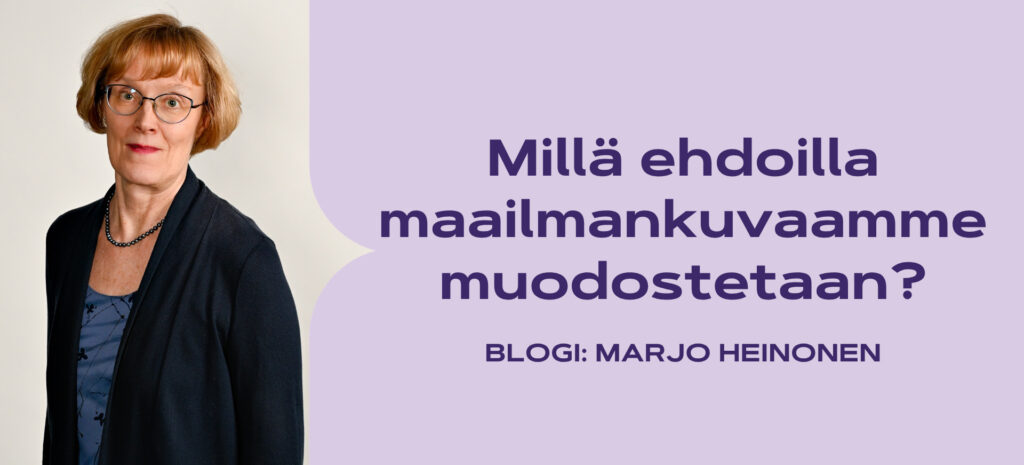
Matleena Ylikoski, a doctoral candidate at the University of Tampere, studies what pluralism in journalism means in the 2020s. In her blog post, Matleena explores how a pluralistic public discourse supports social peace.
A journalist who listens poorly may miss new information
A question familiar to Finnish journalists is: “Who gets to have a voice in the media?” In English, the same question is often phrased as “Whose voices get heard in the media?” The difference between these questions is interesting. Whereas in Finland we wonder whose hands hold the imaginary microphone, in English the question also asks whether anyone is actually being heard.
I’ve been working as a journalist for ten years, and I’m used to giving a voice to anyone and everyone—whether by writing down quotes on paper or online, or by holding a microphone in front of the interviewee’s mouth and waiting for them to finish what they’re saying. Back in the editing room, I then decide which parts of the interviewee’s speech are the most interesting or important and will make it into the published story.
On rare occasions, I’ve been interviewed on the radio or television myself, and I know what it feels like when a reporter suddenly pulls the microphone away from your mouth, as if to say, “We don’t want to hear any more.” I once had a colleague who used to boast that they conducted the shortest interviews in our newsroom. They said they wrote the scripts for their news stories in advance and elicited comments from the interviewee for specific quotes they had already planned. “I know exactly what I want the interviewee to say, and I just ask that. It only takes three minutes,” they would sometimes say.
Public discourse should promote diversity of voices
The issue of access to the media is very concrete, and it involves a great deal of journalistic power. A reporter has the right to decide whom to interview, what to publish, how to frame the story, and how it will be published. The interviewee’s only power is to agree to or decline the interview and to approve their quotes after the interview.
It is precisely the power aspect that makes pluralism in journalism such a complex issue. Audiences may find it difficult to accept the extent to which the media exercise this power, and journalists may find it difficult to shoulder this responsibility with sufficient care. Questions of pluralism are complex, nuanced, and sensitive to changes in context: there are no ready-made answers.
In the age of social media, public debate has partly become toxic, leading to more and more people from politicians to ordinary citizens, to avoid participating in the debate (Finnish Journalists' Association 2023; Erho 2025). In Finland, people have traditionally participated boldly in social discourse (Reunanen et al. 2023, p. 30), but an increasing number of topics are now considered too difficult. One in five journalists reports that they choose not to cover certain stories or alter their content out of fear of being subjected to pressure or harassment (Hiltunen et al. 2025). The fear of hostile reactions thus silences journalists, and the list of controversial topics continues to grow.
How could listening serve as a tool to ease the difficulties of public discourse and promote diversity of voices in journalism?
The power of listening is, of course, a well-recognized phenomenon in communication studies. According to the book Kuuntelemisen voima (eng. The Power of Listening), listening is the key to understanding people, fostering empathy, and ultimately influencing one’s environment: in other words, listening can achieve a great deal. This is due, among other things, to the fact that being heard and seen is such a central part of human basic needs and nature (Välikoski and Ala-Kortesmaa 2025).
In the literature examining dialogue-based interaction, attention is focused on the construction of shared understanding during interaction. Dialogue is not just any form of conversation and listening; rather, it has more specific qualitative requirements. In Taneli Heikka’s doctoral dissertation on dialogic journalism (Heikka 2017, p. 26), the characteristics of dialogue are identified as collectivity, experimentalism, non-judgment, and comprehensiveness (in addition to rationality, emotions are also included). According to Heikka, this kind of dialogue rarely succeeds perfectly.
Conciliatory journalism brings dialogue to journalism
We have explored the power of dialogue and listening first in a mediation journalism research project, in which I participated ten years ago as a reporter, and later in the Sopiva – the Finnish Association for Conciliatory Journalists, where I have been more active in the role of a researcher. When dialogic methods are applied in journalistic contexts, an important question arises: when we listen closely to interviewees, what exactly are we listening to? Do we allow people to speak freely about whatever they want? Is there room for criticism and counterarguments? Is questioning forbidden?
In the spring of 2025, Sopiva, in collaboration with Vikes, organized a series of discussion events titled '“Hot Topics in Multivoiced Media”- the most recent of which was held at the Media Museum and Archives Merkki on June 5, 2025. The topic of the discussion at that time was “War, Peace, and Peace Journalism.” The questions presented above came to mind during that dialogue.
For me, the greatest takeaway from the "War and Peace" dialogue was the discussion that arose regarding journalism’s social responsibility in an era of war and growing insecurity.
''If journalism is expected to promote peace, should it then foster a pluralistic debate in which even critical voices—for example, regarding the militarization of society and the arms race—are heard, or should it rather build national unity by repeating a shared, as widely shared a narrative as possible, and in that way ‘rally the troops around the flag’(as happened in connection with the recent NATO decision)? There are good arguments for both points of view,” Matleena says.
Media pluralism supports social peace
One of the conclusions of our dialogue was that a multi-voiced conversation must also include critical voices and opinions from the “other side.” When criticism is allowed, a much more diverse range of information and perspectives is brought to the table, which can then be used to make a well-informed decision or form a well-informed opinion. (National) consensus is, of course, highly valuable, but for a healthy civil society to reach consensus, it must engage in a pluralistic debate in which differing views are being heard. Forced consensus may hold in the short term, but critical pluralism strengthens consensus in the long run.
This was clearly evident during the Covid-19 pandemic as well. At first, there was broad consensus in Finland that swift and even radical measures were needed to ensure safety, but as the pandemic dragged on, critical voices—which were growing in number all the time—should have been heard as well. If and when these voices were silenced with the argument of the “common good,” it created a great deal of bitterness and mistrust, the bitter fruits of which are still being reaped today. The multi-voiced discussion must therefore continue even after decisions have been made, so that the various impacts of those decisions can be identified and acknowledged.
For me, the power of dialogue and listening has been a transformative insight throughout my career as a journalist and researcher, and together with Vikes, Sopiva, and the research community, we will continue to work toward ensuring that this power better serves the communities to which we each belong.
Text: Matleena Ylikoski
Picture: Vanessa Riki
Sources
Heikka, Taneli (2017). Dialogic journalism: How can journalists participate in the networks of social innovation? University of Jyväskylä. https://jyx.jyu.fi/jyx/Record/jyx_123456789_55417
Erho, Nina. Haastattelujen saaminen on vaikeutunut, arvioivat kokeneet journalistit. Miksi asiantuntijat suhtautuvat pyyntöihin nihkeästi? Journalisti 19.3.2025. https://journalisti.fi/artikkelit/2025/03/haastattelujen-saaminen-on-vaikeutunut-arvioivat-kokeneet-journalistit-miksi-asiantuntijat-suhtautuvat-pyyntoihin-nihkeasti/
Hiltunen, Ilmari; Reeta Pöyhtäri and Aleksi Suuronen (2025). Journalistien kohtaama painostus, häirintä ja uhkailu Suomessa. Tampereen yliopisto.
The Union of Journalists in Finland. Journalistien tiedonsaanti vaikeutunut: poliitikot ja viranhaltijat välttelevät haastatteluja. 25.9.2023. https://journalistiliitto.fi/fi/journalistien-tiedonsaanti-vaikeutunut-poliitikot-ja-viranhaltijat-valttelevat-haastatteluja/
Reunanen, Esa (2023). Uutismedia verkossa 2023. Reuters-instituutin Digital News Report Suomen maaraportti. https://trepo.tuni.fi/bitstream/handle/10024/149682/978-952-03-2961-7-6.pdf?sequence=5&isAllowed=y
Välikoski, Tuula-Riitta ja Sanna Ala-Kortesmaa (2025). Kuuntelemisen voima. Avain ymmärtämiseen, vaikuttamiseen ja empatiaan. Atena. Jyväskylä.