
- Tämä tapahtuma on mennyt.
Voices from the South: Challenges and Solutions of Global Journalism – Seminar
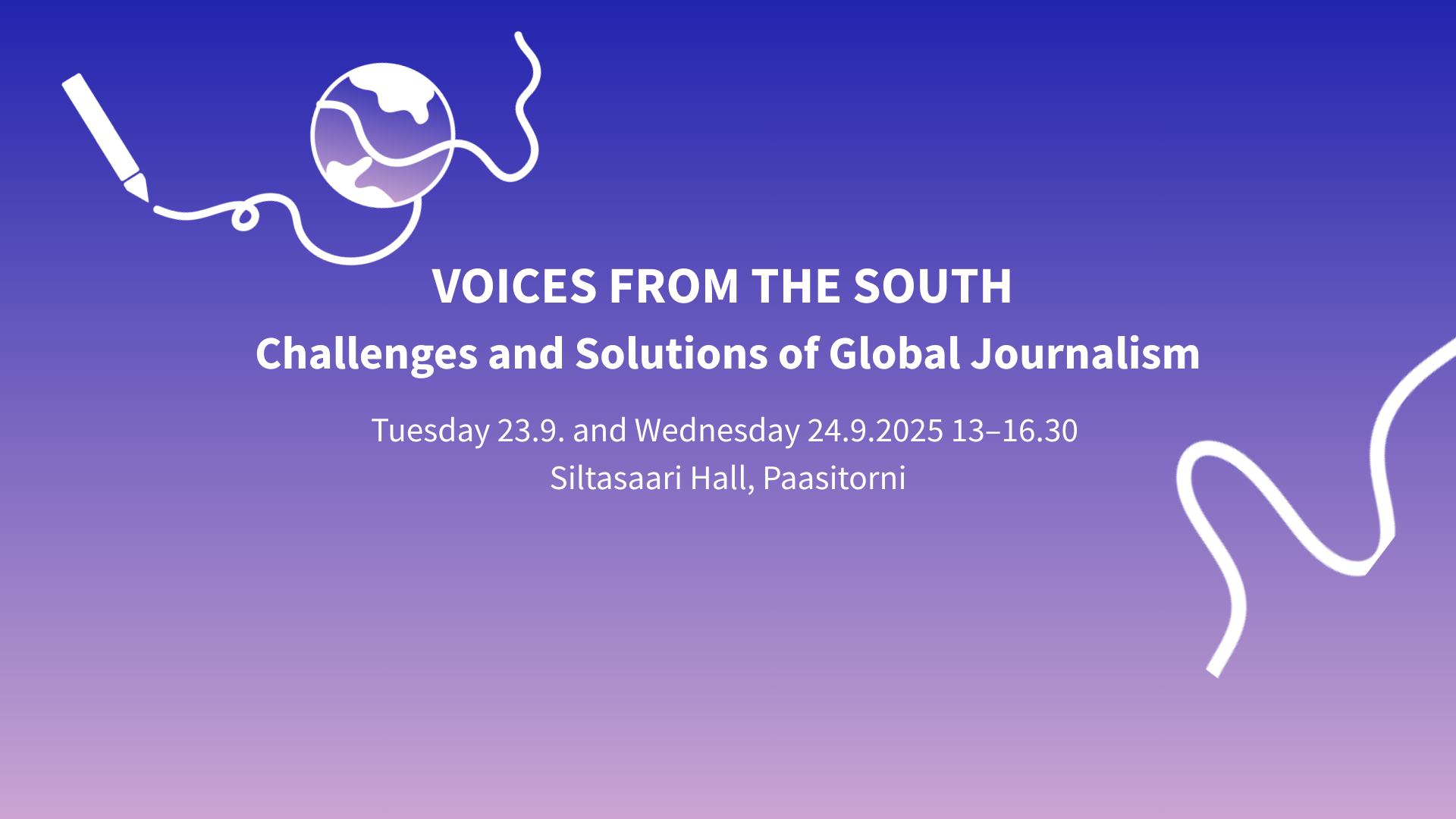
We warmly welcome you to the seminar Voices from the South: Challenges and Solutions of Global Journalism
Seminar speakers include Abigail Hernández (La Sala) and Maryórit Guevara (La Lupa) from Nicaragua; Ndéla Faye from Finland; Habiba Alasow and Farah Omar Nur (FESOJ) from Somalia; Catherine Apalat (Mama FM) from Uganda; Ziada Kilobo (Media Council of Tanzania) from Tanzania and MAY from Myanmar.
The seminar will be hosted by journalists Wali Hashi and Amkelwa Mbkeni-Kapanen.
Day 1 – Challenges and Survival Kits of Female Journalists (Tue 23 Sept, 13:00–16:30)
The first day highlights the position of women journalists and the ways women practice journalism under conditions that restrict women’s rights and freedom of expression.
13.00 – 13.05 Welcome and introduction of the afternoon by Ms Amkelwa Mbekeni-Kapanen, facilitator of the seminar
13.05 – 13.20 More than a story: The struggles of Ugandan women journalists and why gendered media matters, Ms Catherine Apalat, Mama FM, Uganda
13.25 – 13.40 Breaking the silence: Tackling sexual exploitation and harassment in Tanzanian media workplaces, Ms Ziada Kilobo, Media Council of Tanzania
13.45 – 14.00 Gender dynamics in Somalia: Discrimination, harassment, and resistance, Ms Habiba Alasow, Federation of Somali Journalists
14.10 – 14.25 Facing gender violence: Breaking gender stereotypes by leading a group of women journalists and a feminist media outlet in exile, Ms Maryorit Guevara, Founder of La Lupa, Nicaragua (Spain)
14.30 – 15.00 Coffee break and networking
Photo exhibition by Veera Kontula
15.00 – 16.15 Panel discussion: From exploitation to equality - How women journalists are struggling for equal rights at workplaces. Facilitated by Ms Amkelwa Mbekeni-Kapanen
Panellists: Ms Catherine Apalat, Ms Ziada Kilobo, Ms Habiba Alasow, Ms Maryorit Guevara & Ms Abigail Hernández
16.20 – 16.30 Conclusion of the discussions
16.30 End of the seminar day 1
Day 2 – Rise of authoritarianism as a threat to press freedom and safety of journalists (Wed 24 Sept, 13:00–16:30)
The second day dives into journalism safety and the threats linked to the diverse techniques of suppressing press freedom. The speakers are journalists who share concrete strategies for practicing journalism in countries with restrictions on freedom of expression.
13.00 – 13.05 Welcome and introduction of the programme by Mr Wali Hashi, facilitator of the seminar
13.05 – 13.25 MAY from Myanmar - Suffering civil society and the upcoming sham elections in Myanmar
13.25 – 13.40 Security Challenges for Journalists in Somalia: How journalists in Somalia are threatened by terrorism, Government and Fake Journalists?, Mr Farah Omar Nur, Secretary General, Federation of Somali Journalists
13.45 – 14.00 Reporting under pressure: Journalists and elections in Uganda, Ms Catherine Apalat, Mama FM, Uganda Ms
14.05 – 14.20 Reporting under threat: Arrests, intimidation, and self-censorship of journalists ahead of Tanzania’s elections, Ms Ziada Kilobo, Media Council of Tanzania
14.25 - 14.50 Beyond the Nordic illusion: Press freedom under strain in Finland, Ms Ndéla Faye, Finnish-Senegalese journalist and author
14.50 – 15.20 Coffee break and networking
Photo exhibition by Veera Kontula
15.20 – 15.35 Silence is not an option: Exile journalism as resistance, safety strategies, and innovations that defend free expression, Ms Abigail Hernández, Founder of La Sala, Nicaragua (Costa Rica).
15.40 – 16.25 Panel discussion: Press freedom under siege - Stories of resistance and survival. Facilitated by Mr Wali Hashi
Panellists: Mr Farah Omar Nur, Ms Abigai Hernández, Ms Catherine Apalat, and Ms Ziada Kilobo
16.25 – 16.30 Conclusion of the discussions
16.30 End of the seminar day 2
Practical Information
📍 Venue: Siltasaari Hall, Paasitorni, Helsinki
📅 Time: Tuesday 23 Sept and Wednesday 24 Sept, 13:00–16:30
☕ Refreshments: Coffee will be served
🔗 Registration: You can register for both days or choose one (Day 1: Women / Day 2: Safety). Please register by 17.9. to help us arrange the cafe break. Places are limited – secure your spot by registering early!
We look forward to welcoming you to this unique international journalism seminar in Helsinki!
Speakers
Abigail Hernández, La Sala, Nicaragua
Abigail Hernández is a Nicaraguan journalist living in exile in Costa Rica. She is the founder and director of La Sala – mujeres en la redacción, a network that brings together women-led Nicaraguan media outlets in a shared workspace. The initiative aims to strengthen the position of female journalists through collaborative journalism and to expand media perspectives on gender-based violence and women’s rights.
Hernández is widely recognized for her journalistic work on human rights and freedom of expression. For more than a decade, she has practiced journalism under state surveillance, censorship, and systematic persecution, emerging as one of the most prominent journalists of her generation to keep critical reporting alive under Nicaragua’s dictatorship.
Through her active work, she has established herself as a trusted source for international media seeking to understand Nicaragua’s social and political situation. Her appearances in international forums and media outlets have also made her a well-known voice denouncing violations of press freedom and human rights in Nicaragua and across Central America.
At the seminar, Hernández will speak about journalists’ safety in high-risk environments, strategic alliances under restrictions on freedom of expression, and journalistic innovations that challenge traditional newsrooms.
Maryórit Guevara, La Lupa, Nicaragua
Maryórit Guevara is a Nicaraguan journalist living in exile in Spain and the founder of La Lupa. The online publication La Lupa became Nicaragua’s first openly feminist media outlet with a gender perspective, placing women at the center as active citizens and agents of change.
Guevara leads a team of women journalists, most of whom work in exile across different countries, while some remain in Nicaragua. There, under the dictatorship’s persecution, strict security measures are essential to protect both the journalists and their families. Through their work, the team’s journalistic commitment also becomes an act of political resistance that links the defense of freedom of expression with the advancement of women’s rights.
In her personal blog El blog de tu madre, she transforms her own experiences of motherhood, women’s rights, and gender-based violence into journalism committed to justice and human rights.
At the seminar, Guevara will share her experiences of leading a feminist media outlet under dictatorship and patriarchal machismo culture, managing a team of women journalists from exile, and developing narratives that challenge gender stereotypes.
Ndéla Faye, Journalist & Copywriter, Finland
Ndéla Faye is a Finnish-Senegalese journalist and author with over ten years' experience reporting on race, immigration, gentrification, pop culture and social justice in Finland and beyond.
Having worked in both Finnish and international media, she offers firsthand insight into how online harassment and structural barriers affect journalists, particularly those from marginalised communities. Although Finland is often regarded as a bastion of press freedom and free expression, Ndéla has been a vocal critic of the systemic inequities that persist within its media landscape – a theme she will address in her keynote speech.
Habiba Alasow, Gender secretary for the Federation of Somali Journalists (FESOJ), Somalia
Habiba Alasow is an experienced Campaign Coordinator with over six years of experience leading impactful campaigns focused on women’s empowerment, inclusion, and positive social change in Somalia. Most recently, she coordinated social and behavior change communication (SBCC) campaigns delivered through radio drama and social media. The campaign addressed sensitive themes including sexual and gender-based violence (SGBV), inclusivity, women leadership and the rights of marginalized communities, particularly women.
She currently volunteers as Gender secretary for the Federation of Somali Journalists (FESOJ) and was recently elected as Treasurer of the East African Press Council, furthering her commitment to media development and regional collaborations. Her work focuses on amplifying women’s voices, coordinating inclusive dialogues, and creating platforms for community-driven storytelling.
Habiba will speak about workplace harassment targeting female journalists and the consequences of hate speech directed at them.
Farah Omar Nur, Secretary General – Federation of Somali Journalists (FESOJ), Somalia
Farah Omar Nur is a veteran media leader with over 40 years of experience spanning various sectors of journalism, including program production, reporting, the writing of social awareness dramas, professional media training, and university-level teaching for the next generation of journalists.
He has played a significant role in developing the skills of Somali journalists, promoting media independence, and defending press freedom. Farah is currently among the leading figures in regional media, serving as the Secretary General of the Federation of Somali Journalists (FESOJ), where he works in collaboration with national and international organizations to advance a professional and public-interest-oriented media.
Farah will speak about disinformation and hate speech and their effects on journalists’ safety. He will share examples of TikTok fake journalists and other social media actors who spread hate speech, undermining democracy and overall societal trust.
MAY, Myanmar
MAY is a Myanmar documentary filmmaker known for producing and directing socially engaged films. She has directed numerous documentaries, collaborated with development organizations, and taught documentary filmmaking both in Myanmar and abroad. Since 2019, she has lived in Europe, where she continues her film and art projects.
MAY will join the seminar online. She will address the growing influence of China and Russia in Myanmar, focusing on digital surveillance, social control, and restrictions on civic participation.
Catherine Apalat, Mama FM, Uganda
Catherine Apalat is a Ugandan journalist specialised in development communication, gender and media. She is the Station Manager at Mama FM radio station in Kampala, the only women-managed and women-focused radio station in East Africa. Mama FM is very popular among listeners in the Ugandan capital and nearby communities, reaching a coverage area of several million people.
Catherine is deeply passionate about empowering women, particularly grassroots women, and young girls, including persons living with disabilities. Under her leadership, Mama FM has prioritised stories on women’s rights, youth empowerment, and disability inclusion. This has enabled the underrepresented groups to be heard and engage in public debate.
As Uganda is getting closer to elections in January 2026, Catherine is currently coordinating a training programme with journalists across Uganda on election reporting and safety of journalists. Many of the trainees are preparing to cover elections for the first time, gaining the skills and confidence to report responsibly and safely.
At the seminar, Catherine will speak about the struggles of Ugandan women journalists and why gendered media matters, and about the pressures that Ugandan journalists face when reporting about elections.
Ziada Kilobo, Media Council of Tanzania, Tanzania
Ziada Kilobo is a Tanzanian media and human resource professional with over two decades of leadership experience across media, consulting, and organisational development.
At the Media Council of Tanzania, she has spearheaded projects advancing press freedom and safety of journalists and coordinated the Women in Media project, creating platforms that amplify women’s voices in the media and promote gender equality.
She combines her expertise in strategic management with a strong commitment to advocacy, making her a driving force for inclusive media spaces and the protection of free expression.
At the seminar, Ziada will talk about ways to tackle sexual harassment in Tanzanian media workplaces, and about arrests, intimidation and self-censorship of journalists ahead of upcoming elections in Tanzania in October.