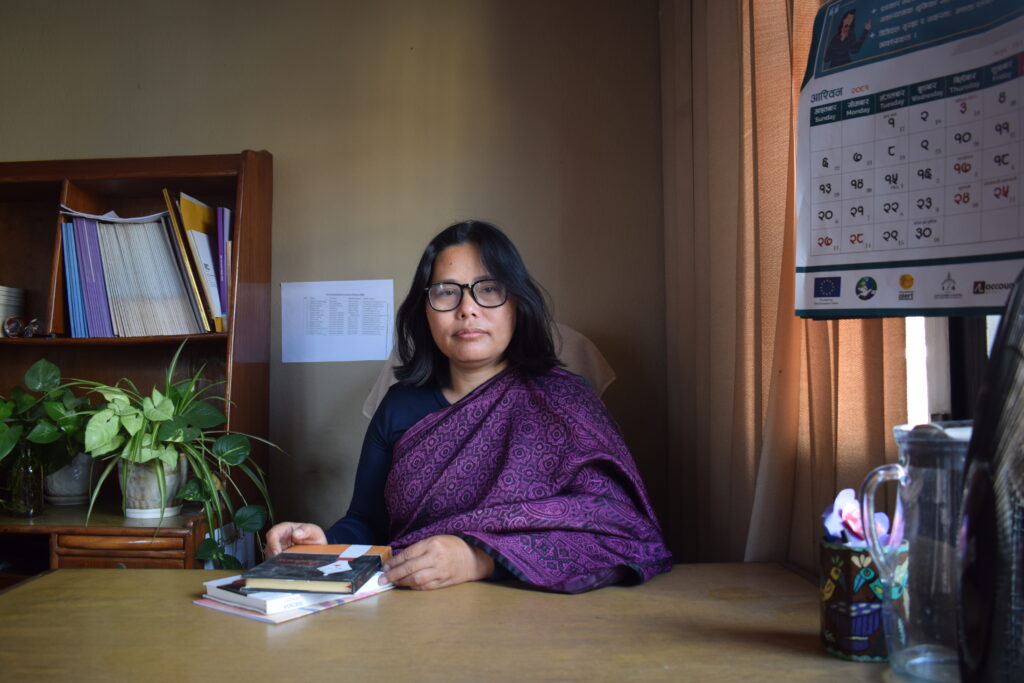
Sonia Awale, 32, editor-in-chief of the Nepali Times, is a rarity. Only about 25% of Nepali journalists are women. There are only a few in leading positions.
”I'm one of the lucky ones”, says Awale.
But there should be more lucky ones. When Awale is invited to participate in panel discussions, she is usually the only woman.
It's a gender inequality issue that affects not only female journalists, but also what kind of topics are covered in the media.
In addition, the number of women affects what working in the editorial office is like, Awale says.
Sensitivity for the individual needs of employees
The weekly magazine has a small editorial staff of just five people. Three of them are women.
On Wednesday afternoon, the only other person present is Vishad Raj Onta, who is writing about the Nepal women's national football team's match against Bangladesh.
One journalist has been working remotely. But they too have probably finished work for the day. Awale used to let his staff go home early in the afternoon on Wednesdays.
She listens carefully to the needs of the journalists and is flexible, for example with regard to days off.
“I think that as a woman, I am more sensitive to the individual needs of workers.”
In many other media workplaces, the situation is different. According to a 2016 report by Sancharika Samuha, the female journalists' organization, many female journalists find it difficult to work shift work, for example. Going home in the middle of the night is not safe.
Women often have more responsibilities at home than men, which makes it difficult to work. At work, they are seen as demanding and unambitious. Sexual harassment is common.
Awale herself has had to grow up as a journalist in a different working environment.
"When I started here, the editor and many of my colleagues were women. I grew up seeing women in high positions who had the power to make decisions."
When Awale started as an intern at the Nepali Times in 2015, journalism was new to her.
"Back then, it was important to have role models around me. They have made me the person I am today," Awale says.
“This has always been a place where there is room to learn.”
From public health student to journalist
In 2013, Awale was still a public health student, working on her final thesis regarding the use of pesticides. The results of the study were alarming: more than 80% of farmers in Kathmandu were using banned pesticides.
Awale wrote an article about the findings in the Nepali Times, which led to other media outlets taking an interest in the issue. Pesticide use became a big topic of discussion in Nepal. Awale was offered an internship at the Nepali Times and was asked by the editor to continue working on the topic.
Eventually, the publicity the issue received led to the Nepalese government setting up the country's first pesticide residue laboratory in Kathmandu. According to Awale, the use of pesticides has since declined significantly.
”I was fortunate to see the impact of the writings”, Awale says.
Seeing the impact prompted her to change the direction of her career. As a journalist, she also felt she could connect with people better than she could as a researcher. By listening to people, she began to understand better what was happening in Nepal.
However, her studies in public health have been useful in the field. Climate and environmental issues feature heavily in the Nepali Times. Sometimes Awale trains journalists from other parts of Nepal on climate and environmental issues.
"Journalists often have little knowledge about everything, but that can also be dangerous. I think it's really important to have a good understanding of the subject you're writing about."
Awale also believes that more thought should be given to how climate and environment is written about. How do you visualise climate change? How can you get people interested in the subject?
There are no hard or soft topics
So how does the gender balance of the editorial staff affect the content of the magazine?
According to Awale, women often have a different perspective. For her, all topics are also equal.
“I don't like the separation into hard and soft topics,“ Awale says
And topics should not be categorised too much. For example, climate and development issues, like social issues, are always closely linked to the economy and politics. For all issues, it is important to get to the bigger picture.
While journalists will of course always have their own interests, Awale tries to distribute the work and topics evenly to all, regardless of gender.
In fact, she would prefer not to have to talk about gender at all.
Inequality and the position of women journalists must of course be addressed," says Awale. But she herself would not want to be seen primarily as a female journalist.
But as a human being.
Text and picture: Saga Sinisalo