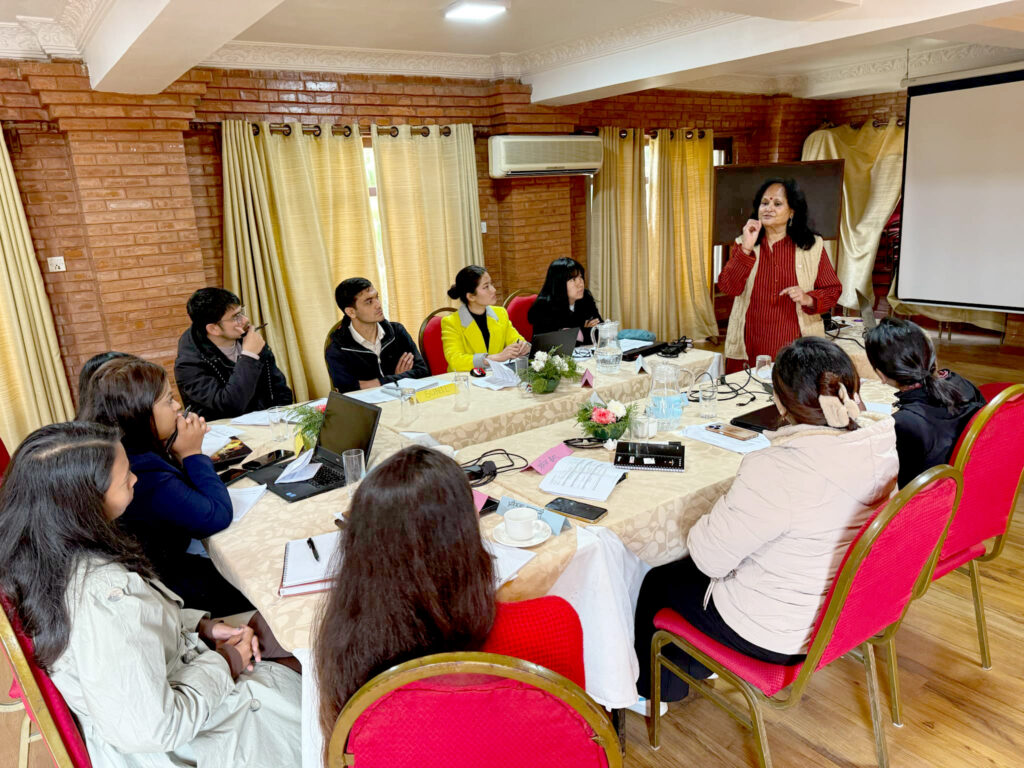
Sharmila Thakuri, an economist and chairperson of the Nepalese female journalists' organisation FEJA, which focuses on economic issues, has been particularly happy lately.
Within a year, she has written two investigative articles that have attracted widespread attention, with the help of the Vikes-supported Nepal Centre for Investigative Journalism (CIJ).
One of the articles looked at the way investment companies raise money from small investors, then bury the company and keep the money for themselves. As a result of the article, the Nepalese government is currently preparing a law amendment aimed at protecting the money of small investors.
Another article revealed how money deposited by ordinary people in cooperatives has been squandered by the financial elite. The case is currently being heard in court. It is likely that people will get their money back.
”The economy is the backbone of all societies,” says Thakuri.
If you don't understand the economy, it's difficult to develop society, says Thakuri. She thinks it is important that women also write about the economy.
But to succeed in a career, you need the support of society and other people.
A single encounter on a bus turned Thakuri into a journalist
Thakuri hails from a small mountain village in the countryside, but completed Grade 11 and 12 in the capital Kathmandu. When school was over, Thakuri travelled back to she home village by bus.
An older man sat next to her on the bus, with whom Thakuri struck up a conversation. The man told her that he was a former journalist. His stories were exciting. For example, he said he had been beaten up as a result of his politically motivated writing.
As the trip was coming to an end, the man said that Thakuri was a good speaker and seemed intelligent. She would make a good journalist! The travelling companion suggested that Thakuri apply for a scholarship for young journalists from the goverments' Information Department.
So she did. She got the scholarship and then a job.
Thakuri found good colleagues, but also police officers who helped her to advance in her career.
”Some senior police officers helped me get in touch with sources. They invited me to police events and shared information with me," says Thakuri.
But the sources were a headache for the young female journalist. According to Thakuri, many people thought she was asking questions because she didn't know anything, not because she was a journalist. She was also expected to perform sexual favours in return for the information people shared with her.
She always made it clear when sources overstepped her boundaries. If they didn't believe, Thakuri would threaten to expose them and take the case to court.
“But the problem was that after that, they were no longer my sources,” says Thakuri.
However, the situation has improved somewhat as a result of the Metoo movement. Men have started to fear women. In a good way, Thakuri says, laughing.
Women have to prove their skills all the time
Thakuri believes that women are more straight-backed and reliable as journalists than men. It's all about how patriarchal structures affect people.
In Nepal, men are expected to support the whole family. Families are often large because they include grandparents, for example. If it is possible to earn an honest living, men will of course do so. But if that is not possible, they will earn a living by any means necessary.
According to Reporters Without Borders, bribery of journalists is widespread in Nepal.
Women are affected by the same structures in a different way. Because they are not seen as breadwinners or capable workers, they are constantly having to prove their qualifications. Women therefore cannot afford to take the same risks as men.
"If women are told not to cross a line, they will not cross it. This is my experience," says Thakuri.
The fact that women are not considered as capable as men is reflected, for example, in their pay.
“My husband is also a journalist, and he is often offered more money for his work than me,” says Thakuri.
Thakuri has benefited from the skills she learned in her investigative journalism training
CIJ's investigative journalism training courses for women, funded by Vikes, are according to Thakuri much sought after. There are no other independent media organizations like CIJ in Nepal, and women have fewer opportunities to develop their careers than men.
She herself learned a lot about data visualisation and how to use data to find topics.
“Kiran Nepal, editor-in-chief of CIJ, taught us how data can speak for itself,” says Thakuri.
In addition to writing investigative articles for CIJ and Himal Khabar, Thakuri has been able to apply her new skills elsewhere.
The Nepalese government has an employment programme, the results of which it has openly touted. When Thakuri took a closer look at the numbers, it turned out that they didn't say what they claimed to say. It was the party politicians who benefited from the programme, not the job seekers.
A new story emerged from the findings. Perhaps one that could spark another social change.
Text and picture: Saga Sinisalo