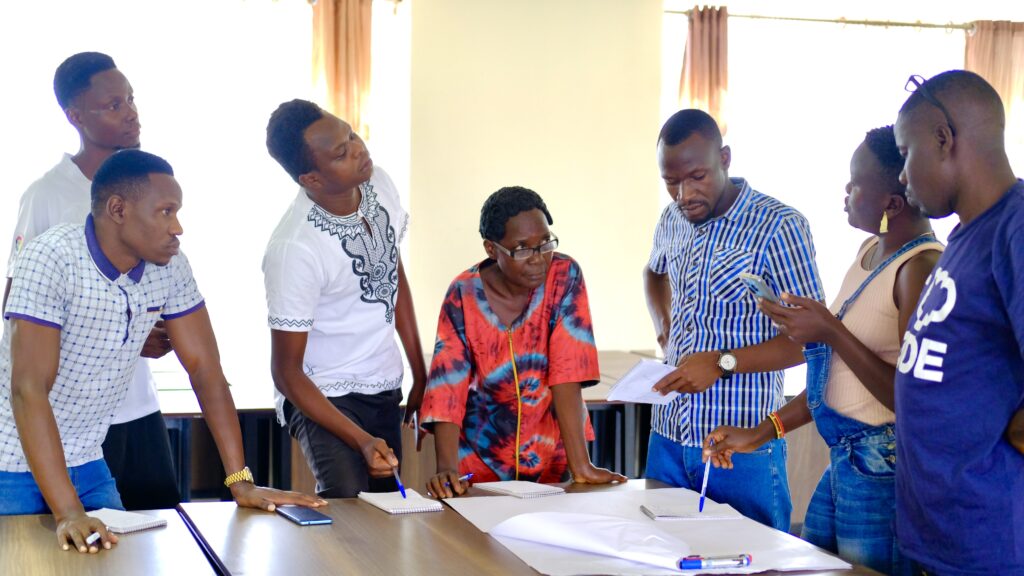
The event, organized at the Media Museum and Archive Merkki, was part of a collaboration between Vikes and the Finnish Association for Conciliatory Journalists' Sopiva to promote a constructive and multi-voiced debate. The second event of the spring discussed the Marthas' vegetarian food policy and the “meat revolt”: why do food debates get overheated? The discussion was introduced by Mikko Hautakangas, a journalism researcher and representative of Sopiva ry from the University of Tampere.
The discussion was conducted using the Erätauko-method, which supports constructive dialogue, especially on emotionally charged topics. The participants were journalists, researchers, food culture experts and professionals working in the field. The quotations in this text are direct extracts from the debate.
Food unites locally and globally
Food unites people across borders - but it also raises many complex issues. The debate called for a shift from disputes over individual food choices to broader structural issues such as land use, EU agricultural subsidies, the potential for food processing and the dominance of a few big retail chains. It was noted that Finland should be able to create a broadly agreed strategy that would combine both sustainable food production and security of supply aspects.
In the public debate, food producers in particular like to emphasize the importance of domesticity, and the voice of Finnish producers deserves to be heard in the food debate. Public speeches during the Martha crisis also called for a “domestic challenge” to overcome the vegetarian-meat dichotomy. However, the debaters pointed out that, on the other hand, domesticity is not a simple value when, at the same time, poultry is exported to China and inputs are imported even from warring countries. The sustainability of food production must ultimately be considered from a planetary perspective.
“We need more pillars for the discussion, including philosophical reflection on what a good life is and how we can contribute to it through consumption - and whether we really want to contribute to it.”
More in-depth journalism about food is needed
There is a lot of information available on global food production, but the issues are complex for consumers and journalists alike.
"Should I buy Spanish tomatoes because they are grown in a more natural environment? But Spain has water shortages and a poor human rights record. On the other hand, there are also problems of labour exploitation in the production of Finnish vegetables... It is difficult for the consumer to know what is really ethical and what isn't."
It is also challenging for a journalist to write stories that take into account all dimensions of food production - the environment, human rights, domesticity and the situation of farmers. But there is a demand for high-quality, diverse and critical food journalism. This would require a journalist with a deep understanding of food production as a whole and the courage to challenge familiar narratives.
The panelists wanted food journalism to be relatable and provide context, for example by making historical developments visible.
"It is not the food producers who are to blame, but the structures. These structures should be carefully explained up to the reader: what does it take to produce a particular food."
Media scandals can make us learn something new
Medias' role in facilitating constructive debate was recognised as important - but at the same time the media's tendency to stir up controversy was criticized. The debate also considered whether the audience's interest is too narrowly perceived by editors, who track it through reader data and “algorithmic audience perception”. Several interviewees seemed to feel that they did not belong to the target audience that journalism currently seems to appeal to.
"Media houses should be held accountable for the direction of the debate. But it's not the responsibility of individual journalists - journalists will do the best they can."
Still, the controversy can also have a learning value. The discussion covered many of the tensions and stages in the debate sparked by the Marthas' vegetarian food campaign, and recognizing these can help to reduce conflict and strengthen positive opportunities in the future.
Welcome to the next debate in June
"If the Martha debate had been held with everyone present to discuss the issues, as we're now, would there have been a scandal? There cannot be too many of these debates."
"The topmost feeling is that I am lucky I came here. If I were a journalist, I'd have a bunch of ideas to write about. I can warmly recommend fellow journalists to attend these events!"
The last Moniäänisen median kuumat perunat discussion of the spring will take place on Thursday 5th of June 2025 from 17-19 at the Media Museum and Archive Merkki. Follow Vikes and Sopiva's communications to be the first to know about the theme of the next discussion. You can subscribe to the Sopiva ry newsletter directly to your email by clicking on this link.
Text by: Tiina Helin and Mikko Hautakangas
Picture by Vanessa Riki